

Medical marijuana inhabits a legal no-man’s-land in Seattle
By Lucas Anderson and Meghan Walker
July 2011
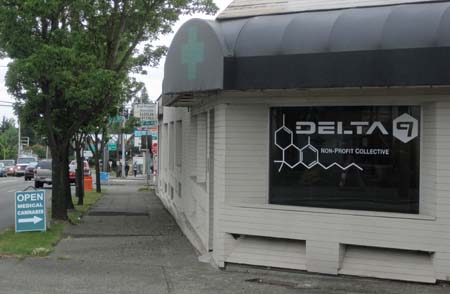
Medical marijuana dispensaries are opening all over Seattle, including one on Lake City Way in Wedgwood and, apparently, another down the street in Maple Leaf.
As those shops moved to open, their legality became more of a gray area. That’s true across the city, although Seattle this week moved to try and further clarify the law.
A map of dispensaries in North Seattle
In Ballard, a modest house on a busy street is the new home of Fweedom Collective. There, Tyler Godfrey has been open for just a few months. When he opened shop, it looked as though dispensaries would soon gain protection under state law.
Fweedom serves only patients who have an authorization from their doctor. Godfrey says it’s important that patients have access. “Medical marijuana patients need a place to obtain their medicine, because if they can’t do it in a professional manner like this, they have to go to a criminal market, which then affects the community.”
This is reality for medical marijuana users, who have around 50 pot shops in Seattle that supply them with their medicine. The catch? All of them are now breaking state law.
A-J-a-Day? from Lucas Anderson on Vimeo.
Medical marijuana has been legal in Washington for over a decade, but current law technically forbids businesses like Fweedom. But, King County prosecutor Dan Satterburg has been firm on the stance of medical marijuana: it’s a low-priority issue in the city, so the dispensaries are left alone.
The debate extends beyond advocates and lawmakers; some people fear addicts could exploit the medical marijuana system. Roger Roffman, a faculty member in the University of Washington School of Social Work, studies drug and alcohol addictions. He says he’s seen marijuana-dependent patients who have sought out medical marijuana recommendations in order to avoid arrest. While Roffman acknowledges there are legitimate patients, he fears abuse.
He says it’s not just the patients who might be exploiting the system, but also those who run dispensaries. “We’re dealing with people exploiting as growers and distributors, people exploiting as patients, while we as a society are trying to get our heads on straight about legalizing and taxing and regulating marijuana. We have a very substantial number of people… are not ill…and who are using the authorization system as a way of protecting themselves from arrest. It’s almost as though we’re not willing to acknowledge the elephant in the living room.”
As the law stands now, a patient can be given an authorization from their doctor to grow up to a 60-day supply of their own medicine, amounting to 15 plants or 24 ounces.
But marijuana can be hard and expensive to grow and not all patients want to do it. That’s where dispensaries like Fweedom come in; they allow patients easy access to their medicine and are run by patients themselves who have the legal right to grow, like Godfrey. The marijuana culture in Seattle has given people like Godfrey the confidence that their shops won’t be raided.
That’s a similar plan to Greenside Medical’s, 9804 Lake City Way N.E. Our story on Greenside from last month is here.
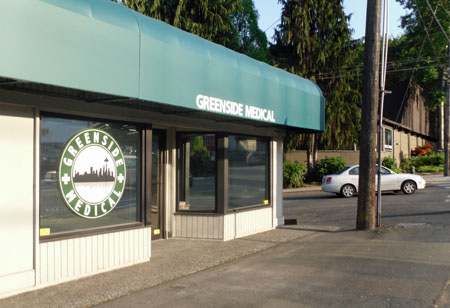
(Side note: Police report somebody tried to bust into Greenside the night of July 6 by ripping a hole in the roof. They didn’t make it; the store has magnetic locks, barred windows with protective glass and security cameras.)
Lawmakers worked this legislative session to carve out a bill to address the issue. State Senator Jeanne Kohl-Welles introduced Senate Bill 507, which took the dispensary issue head-on, and created a provision that would have allowed dispensaries to operate legally in the state. After four months of working its way through the state legislature, the bill went to Governor Chris Gregoire on April 29.
Gregoire partially vetoed the bill, dashing the hopes for dispensary legalization this year. According to a spokesperson from her office, Karina Shagren, the governor was concerned that state employees could be federally prosecuted if dispensaries are legalized.
The bill had Washington State employees regulating the marijuana industry, potentially leaving them vulnerable to federal prosecution for dealing with marijuana shops that were legal according to state law but violated federal law.
Kohl-Welles believes the threat doesn’t hold up, “I have a hard time imagining federal agents going after state employees doing their job under the law.” Regardless, the governor’s veto required Kohl-Welles and other lawmakers to pull back and reassess. In the legislative special session, Kohl-Welles pushed a new bill that would have circumvented the state employee issue by making dispensaries legal across the state but letting each city and town decide whether or not to allow them in their jurisdiction. However, the bill fell short by one vote and was abandoned.
Now that the legislative sessions are over, Seattle is left to make sense of the new law left by Gregoire’s partial veto of SB 5073.
The new bill states that all dispensaries are permitted to serve just one patient every 15 days, or two patients a month, potentially leaving all dispensaries at risk for prosecution. The new law will take effect July 1. However, many Seattle officials are working on a way to save city dispensaries from the restrictive law. Kimberly Mills is with the Seattle City Attorney’s Office. She says the city attorney, county prosecutor, mayor’s office, city council and police department will all work together to draft city legislation to protect dispensaries. “There are still more questions than answers; the whole situation just became even grayer,” said Mills.
Back at Fweedom, Godfrey shows a patient his product. The patient takes a big sniff of “Perma Frost,” and says he’ll take a gram of it.
Godfrey says he’ll continue his work at Fweedom, despite how fuzzy the law has become. “Collectives are a necessity; we keep people off the illegal drug market. Hopefully the city recognizes how safe and important that is.”
This story was produced for Next Door Media by students in the University of Washington’s Entrepreneurial Journalism course.


Greenside Medical is a very nice dispensary. Glad to hear their facility held up.
Hopefully soon this will not even be an issue, given that next year the law in this state will change (with the backing of every state and federal representative in WA as well as health regulators and big business interests). The only ones (other than criminal enterprises) that will suffer are the medical marijuana businesses as the state will be selling it legally through the liquor stoes - no doctors permit needed. I assume the medical distributors will still exist as a free/prescription place, but also assume that their business will decrease alas. I do not use marijuana myself but absolutely support the states’ efforts to legalize, sell and tax it.